


CHALLENGING SITUATIONS
Special Mobility
BUTTERS
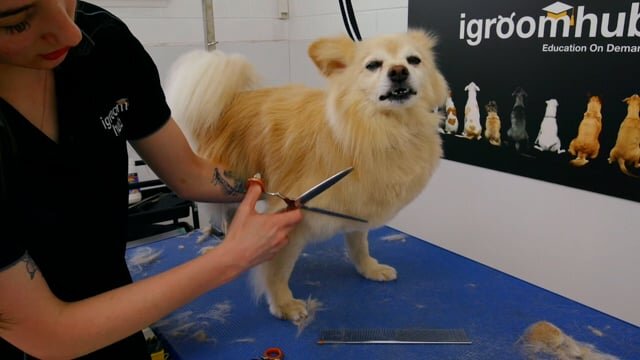
Butters is a lively little Pomeranian who was born with an impairment affecting one of his back legs. He still needs all the usual grooming care, but how Jess gets there needs to change around what Butters can comfortably do.
Throughout his scissor groom, Jess adapts his position, lets him sit when he needs to, supports his affected leg and works efficiently around the areas that are harder for him. It’s a lovely example of something that matters enormously with physically compromised dogs: the groom doesn’t have to look the same on both sides if getting it “perfect” asks too much of the dog

Part 1 | Let the groom fit the dog
Butters’ owners like his feathering taken fairly short while keeping his natural double coat, so Jess starts by shaping his rear before moving through his underline, front legs and chest.
But Butters gets a say in how that happens. If sitting is easier, he sits. If his affected leg naturally crosses or stays lifted, Jess works around it rather than repeatedly trying to put him into a textbook grooming position. The shape still comes together, just on Butters’ terms.
Part 2 | Comfort before perfect
The affected side needs even more adaptation. Jess supports Butters’ leg and thigh, works quickly around areas he finds difficult and deliberately avoids hanging around trying to perfect every last hair.
She’s also quite clear that the two sides may not match perfectly, and that’s okay. The priority is not aggravating Butters for the sake of a technically perfect finish.
Dogs with physical challenges may also need more breaks, shorter working periods or a groom broken into manageable stages. Watch the dog in front of you, give them time when they need it and work with the positions their body can comfortably offer.
Jess finishes Butters with his tail, a light tidy of the naturally fluffy head and some final blending through the chest and neck. He’s neat, comfortable and still very much himself.
