

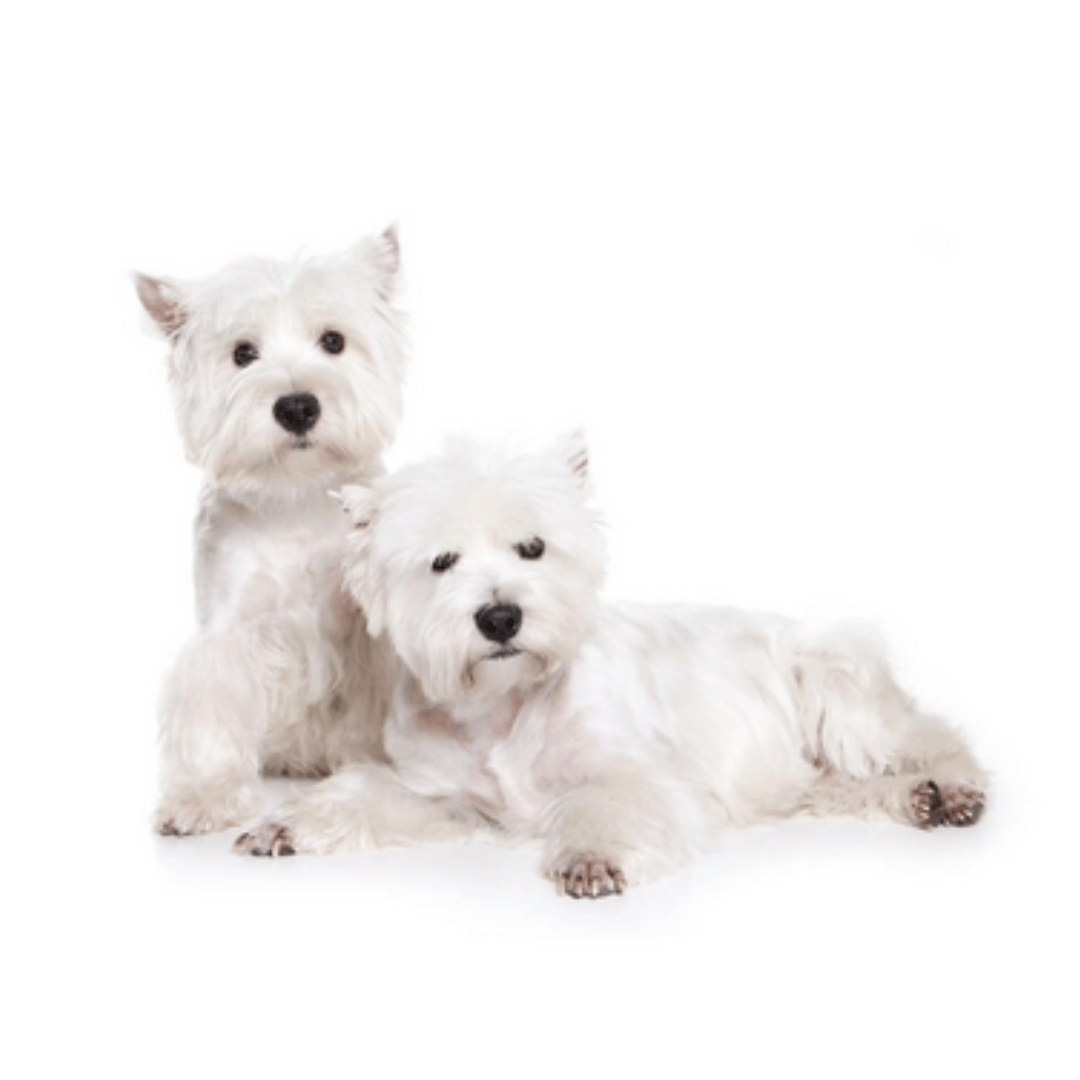
West Highland White Terrier
ALICIA FRAGIADAKIS
POPPY
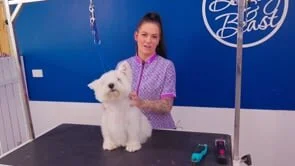
Poppy gives Alicia a few extra things to work around. Her skin is being treated and she has lost coat in places, while an ear infection means she isn’t carrying her ears as she normally would.
Alicia adapts to what’s there while still teaching the underlying Westie shape, making this a useful lesson in separating the ideal pattern from the individual dog standing on your table.
This tutorial is also available as a fastForward
Part 1 | Setting & blending the Westie pattern
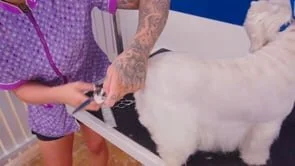
Poppy’s owners prefer her shorter, so Alicia uses a #6 rather than her usual #4. That makes blending the clipped jacket into the furnishings more challenging, and Alicia spends time showing how to flick the blade away from the body rather than stopping and creating a hard line.
She also maps out the shoulder, chest, skirt and rear transitions, explaining the lines that create the Westie silhouette beneath the haircut.
Part 2 | Carrot tail, legs & furnishings
Poppy has a kink in her tail, so Alicia uses the remaining coat to disguise it while creating the tapered carrot shape.
The rear feet are kept tighter than the front, the front legs are shaped into strong cylinders and the skirt angles from shorter at the rear to longer towards the front. Alicia also demonstrates how carding out excess undercoat can dramatically improve difficult clipper lines and transitions on a coat that would traditionally be stripped.
Part 3 | From pet head to spray-up
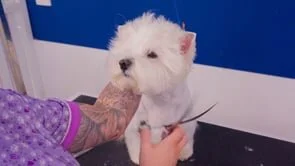
Because Poppy’s ear infection affects how she carries her ears, Alicia has to work with a less-than-perfect starting point. She first creates an everyday Westie pet head, retaining hair around the eyes for that characteristic cheeky expression rather than clipping them clean.
Then comes the bonus lesson: Alicia sprays the coat up in layers, refines the circle and adds white chalk to show how the same head can be taken towards a competition-style finish.
Study Notes | Key Concepts
-
#6 wide blade used (#4 blade preferred for traditional Westie trims).
Clipped down back, leaving enough coat to form a proper carrot tail.
Flick and stretch skin to blend body into furnishings and avoid harsh clipper lines.
Transition lines set from elbow down, ribs out to skirt, maintaining correct silhouette.
-
Carrot shape: thicker at base, tapering to tip.
Tip rounded, sides tapered with scissors, under-tail clipped short.
-
Rear feet: very tight, smaller than front per breed standard.
Front feet: tighter but cylindrical, avoiding tapering at pasterns.
Legs shaped into cylinders: comb down and trim evenly without narrowing at joints.
-
Skirt angles from higher at back down to front legs.
Carding knives recommended to remove dead undercoat and improve clipper finish.
Strip or card after clipping to better blend transition areas and reduce clipper lines.
-
Ear tips clipped only at very tip using shortest blade.
Semi-circle cut from nose to ear tip, using curves or straight scissors.
No shaving over eyes; maintain cheeky look by thinning front eye hair.
Ears should be the highest point – remove any hair taller than ear tips.
-
Spraying up in layers with dog-safe hairspray (Plush Puppy Hold).
Round shaping with scissors after spray sets.
Light chalking to enhance clean, white appearance for competition finishes.
