

At the highest level, grooming isn't just about making a dog look tidy. It's about making it look correct.
There's a difference between a dog that has been groomed and a dog that looks like it should. The first is about technique. The second is about understanding - understanding the breed standard well enough to know what correct actually means for this dog, and understanding the individual dog in front of you well enough to know how to get there from where you're standing.
Alicia Fragiadakis demonstrates both in two tutorials that couldn't look more different from each other. Prince is a Bedlington Terrier. Tilly is a Scottish Terrier. One is all flow and softness, one is all structure and precision. But in both cases, the coat is being used to do something beyond just covering the dog - and watching Alicia work through that thinking is one of the more useful things you can do as a groomer, whatever level you're at.
Using coat to fix what structure can't
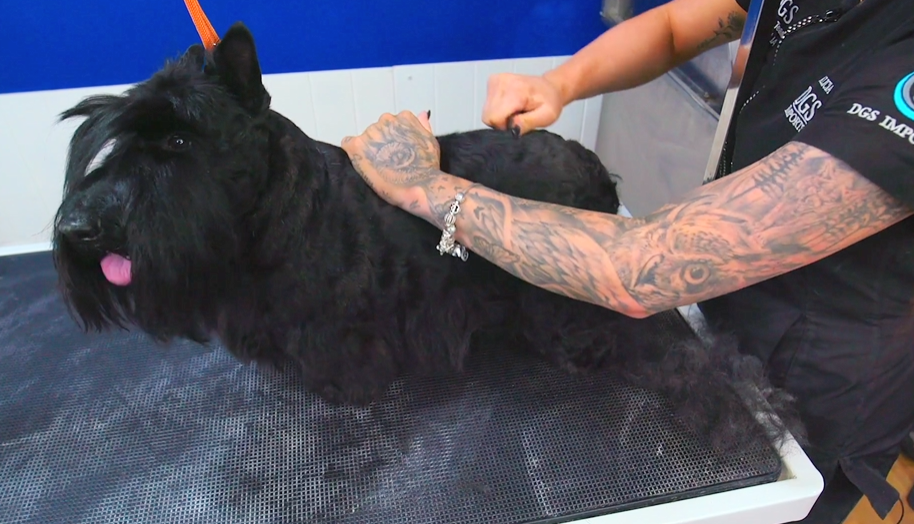
Tilly is slightly bum-high. The breed standard asks for a level topline. Before Alicia picks up a stripping knife, she looks at the dog and makes a plan - she'll take the rear short and leave more length through the middle, using the coat to create the appearance of level where the structure isn't quite delivering it. The mirror on the back wall isn't decorative. She checks that topline throughout the groom, adjusting as she goes.
This is what separates show and competition grooming from a tidy pet trim. The profile has to read correctly. If the standard asks for a level topline and your dog is bum-high, you solve it with the coat. If the standard asks for a narrow head that still looks strong, you leave fill through the sides of the mouth rather than taking it tight. Every decision is in service of the same question: does this dog look like it should?
When the coat itself is the variable
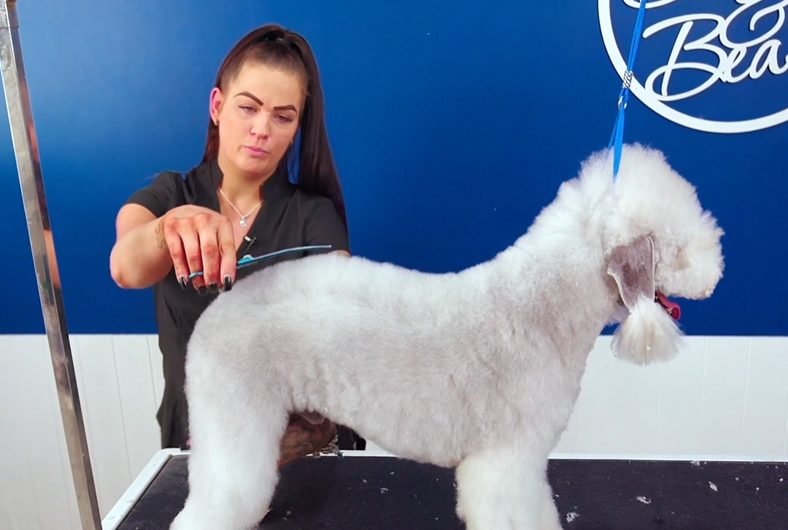
With Prince, the challenge is different. The Bedlington coat is exceptionally soft - so soft that standard scissoring habits work against you. Short cuts with a small scissor put holes in it. You use the longest scissor you have, take big snips, comb-cut constantly. And the breed itself goes against instinct: there's a natural rise over the loin that you groom toward rather than correct. The topline rises and the underline mirrors it. Where the Scottie asks you to impose structure, the Bedlington asks you to follow what's already there.
Both require the same foundation - a thorough knowledge of what the breed is supposed to look like - but they ask for it in completely opposite ways. On the Scottie, you're working against the dog's structure to achieve the profile. On the Bedlington, you're working with the dog's natural lines to reveal it. Getting either wrong, in either direction, produces the same result: a dog that doesn't look like it should.
What this looks like in practice
Alicia talks through every decision in both tutorials. Why the Scottie jacket needs carding after stripping so the undercoat doesn't pillow the top coat. Why nothing on a Scottie should come outside the shoulder - legs, rear, anything. Why the Bedlington head needs to be well filled between the eyes with no visible stop, and what the 50 blade reverse on the ears actually achieves. Why you'd take the tops off a Bedlington's toes to make them look longer rather than filling them in.
These aren't things you pick up from watching a single groom. They come from years of studying breeds, competing on them, and developing the kind of eye that can look at a dog and immediately see the gap between what's there and what should be. Watching Alicia bridge that gap - twice, on two very different dogs - is about as good an education in this kind of thinking as you're going to find
Alicia's complete masterclass on Prince the Bedlington and Tilly the Scottish Terrier are both available to Members inside igroomhub, and available to rent individually on igroomschool - Prince here and Tilly here.



If your clients can't tell the difference between "we're closed" and "we're upset with you," that's not on them. That's a business with no system underneath the relationship.