The Industry Certification Pathway: how and why it was built
Well, it didn't start with a plan.
igroomhub launched in 2017, and not without some eye-rolling from the industry. The prevailing opinion at the time was that you couldn't learn dog grooming online - and absolutely, that's true. We never said you could. We launched igroomhub as grooming school owners who wanted somewhere for our students to revise, go deeper, and keep learning after they'd finished their foundation training. A place to look something up at 10pm when a tricky breed was booked in for the morning. A library, not a classroom.
For the first few years, that's exactly what it was.
But somewhere around 2022, a different question started taking shape. We had years of content behind us, a platform that worked, and a clearer picture of what new groomers actually needed after they left foundation training. And we realised we had the pieces to build something more structured - not just a library to dip in and out of, but a genuine, guided pathway.
That's when the IC Pathway started to become a real thing.
From workbooks to something much better
Dog Diversity has been training groomers in Melbourne since 2006, and for most of that time, the theory component of our courses looked the way it looks at most grooming schools: a workbook. Handwritten notes, printed pages, diagrams filled in by students at the start of their four weeks. It was functional. It did the job.
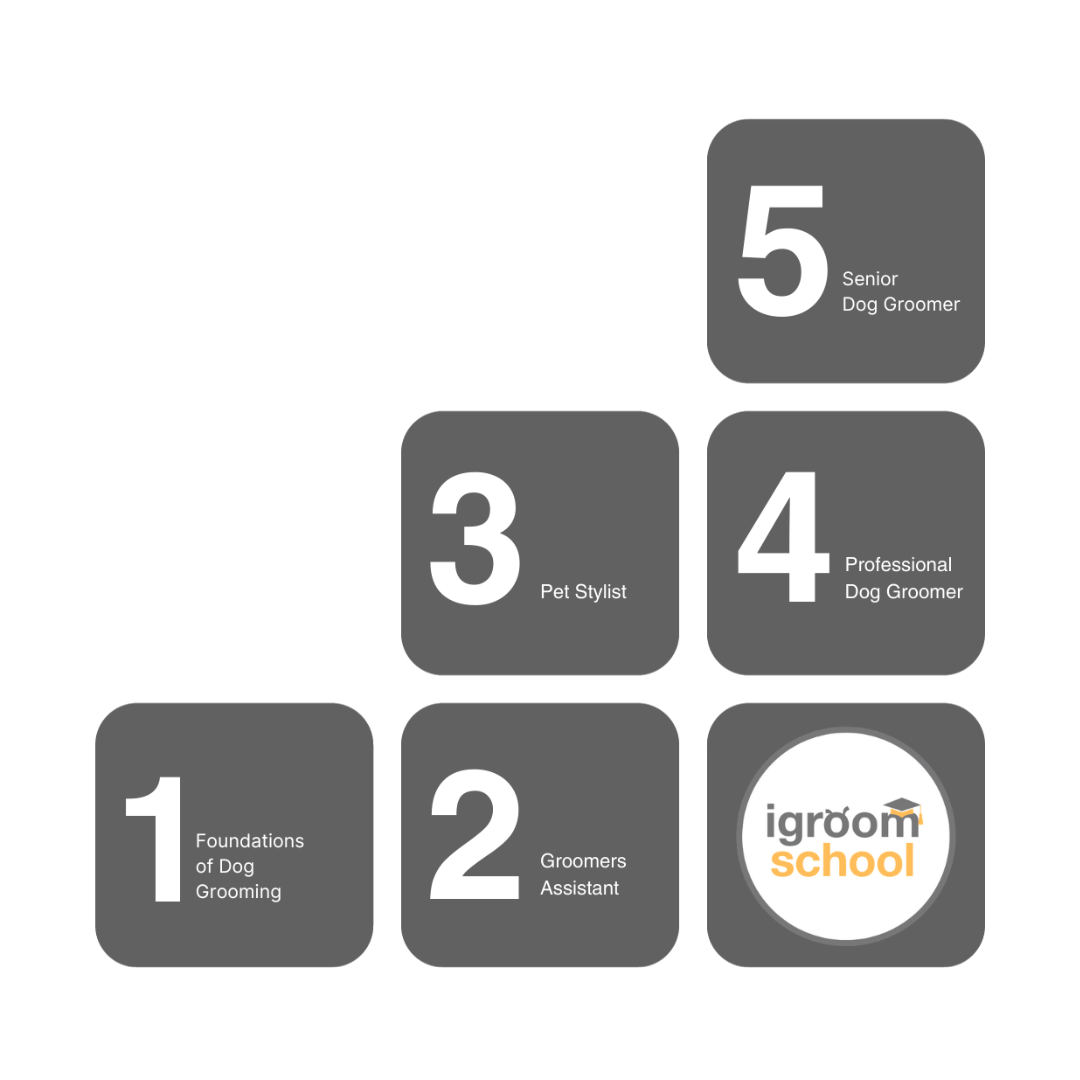
The first thing we did was take everything that lived in those workbooks and rebuild it as a structured online learning experience. Not just PDFs uploaded to a website, but video-supported lessons, assessments, exams, and a framework students could work through independently before arriving at school. That became Block 1.
Dog grooming is a practical trade, but practical skills sit on top of theoretical knowledge. Understanding coat types, canine behaviour, safe handling, first aid, equipment selection and workplace safety doesn't happen by accident. The better a student's theoretical foundation, the more productive and confident their practical training becomes. Block 1 exists to build that foundation - so that when a student walks into a grooming school for the first time, they already know the language of the trade.
It freed up the classroom time. It meant students arrived already prepared. And it worked!
Block 2 followed - the groomer's assistant level, covering the skills that get someone job-ready in a support role. Block 3 became the pet stylist level, built around the hands-on training students complete during their practical weeks. The structure emerged naturally because it mirrored the real progression of a groomer's skills - and because we'd been watching that progression play out for over twenty years.
What we ended up with was a program woven around the practical training: Block 1 in the weeks before arrival, the hands-on component in the middle, and Block 3 to consolidate and complete the pet stylist certification in the weeks after.
The question nobody was answering
But then came the harder question - what happens next?
Plenty of grooming schools can help someone get started. Far fewer have a structured answer for what happens during the next two or three years, when new groomers are building confidence, making mistakes, refining technique and developing professional judgement.
Every groomer who completes a foundation course - ours or anyone else's - leaves with a real gap between where they are and where they need to be. Not because the training was bad. Because dog grooming is a trade, and trades take time. You need repetition. You need to work through a huge variety of dogs, coats, temperaments and situations before the skills become instinct. That process takes years.
The industry didn't have a structured answer to that. There was no clear path for a new groomer to follow after finishing their initial training - no drip-fed curriculum, no benchmarks, no way of knowing whether the skills were developing the way they should be.
Blocks 4 and 5 are our answer to that gap.
They're not a course you complete in a few months. They're designed to sit alongside the first years of a grooming career - slowly releasing content, practical assessments and feedback checkpoints at a pace that matches real working life. Each unit is built to push skills a little further, a little at a time. There are feedback pit-stops where students can upload their work and hear from industry educators. There are benchmarks so groomers can track where they're at.
It's a handhold for the years when a new groomer most needs one.
Why it's not just a Dog Diversity thing
The IC Pathway is built on decades of foundation training at Dog Diversity, and on the full depth of igroomhub's content library. But it was always designed to be bigger than one school.
Dog grooming education in Australia has no universal standard. Schools teach different things in different ways, and the experience a student gets varies enormously depending on where they train. We wanted to change that - not by telling every school how to run their practical training, but by offering a theory and assessment framework that any quality school could build around.
The schools delivering the IC Pathway share more than a curriculum - they share a commitment to teaching with kindness - to grooming education that puts the dog's experience at the centre, and treats students as professionals in the making. Schools in Perth, Tasmania and Victoria are now delivering the IC Pathway alongside their own practical courses. The hands-on training is theirs. The structured theory, the progressive assessments, the ongoing Blocks 4 and 5 support - that's the pathway, sitting underneath it all.
In 2026, igroomschool was endorsed by the Pet Industry Association of Australia (PIAA) as an approved education resource - recognition that the pathway meets a standard the broader industry stands behind.
The goal has always been the same: groomers who are genuinely prepared for the work, and an industry that takes its own education seriously.