F*ck Craft: Great Grooming Is an Art
There's a word we've always preferred over craft, and that word is trade.
Trade has weight. Trade says you know something, you can do something, you were taught by someone who knew before you. Trade connects you to a lineage: the plumbers and the cabinetmakers and the shearers, the people who showed up, learned the thing properly, and did it with their hands every day until it was second nature. We like trade. Trade has never embarrassed us.
But trade has a problem - it's cold. Cold like the inside of a pipe. Cold like it describes the what and the how but has nothing to say about the why. Nothing to say about the part where you step back from a dog and feel something.
So then you reach for the other word. Art.
And art almost goes too far in the other direction. Art conjures John Lennon glasses and a PhD and someone explaining at length why their work is actually a meditation on the colonial gaze. Art sounds like it needs a statement. Art sounds like it has opinions about you.
Except…
Except we keep coming back to it, because nothing else fits. Not craft (too folksy, too ceiling-y, too much like a weekend market). Not trade (too cold). Not skill, not technique, not even excellence, though all of those things are true.
Art. The deliberate shaping of something into more than the sum of its parts. The trained eye responding to what's in front of it. The finish that doesn't just tick boxes. The one that -bang- lands.
Great grooming is art. We're saying it! And here's why…
The moment you just know
Every groomer reading this has had the experience.
You step back. You look at the dog. And something in your chest settles: a quiet, certain yes. The finish is right. Not technically correct, not adequately executed. Right. The whole picture sings.
And it's not just the picture, it's the dog. The eyes and the expression match the body, and everything is in agreement. Whatever was a little too much or not quite enough has resolved, and what's left is an animal who has become the best version of himself. You see it in how he carries himself on the table. You feel it somewhere behind your sternum. The eye and the heart arrive at the same answer at the same time, topknot or not.
You also know the opposite feeling. The finish that's clean, that ticks every box, and still sits slightly wrong. You can't always name it. You circle the dog, take a bit more here, adjust something there. You're chasing a feeling you can't fully articulate.
That feeling is your eye talking, and it knows things your conscious brain hasn't caught up to yet.
The eye is a muscle
Here's what we've come to understand after years of doing this: the eye is not a passive observer. It's an active instrument, and like any instrument, it develops with use.
Early in your grooming life, the eye is mostly checking boxes. Are these ears even? Should I start clipping from here, or here? Is this the best way to hold the leg? These are technical questions, and the eye is a technician.
But something happens over time. Through hundreds of dogs, thousands of decisions, years of looking and adjusting and stepping back and looking again. The eye stops checking boxes and starts reading the whole picture at once. It starts responding to proportion, to weight, to balance, to the relationship between one part and every other part. The heart starts tuning in too, like a theremin finding its note, and eventually the two of them are playing the same frequency, and you just know.
This is not a mysterious gift that some people have and others don't. It's accumulated visual experience. It's pattern recognition built from repetition. It's an entirely learnable skill, but it has to be trained, not just used.
What the eye is actually reading
When a groom lands and you feel that yes: what has your eye actually seen?
Proportion. Always proportion!
Proportion in grooming isn't arbitrary. The breed standards that govern how dogs are judged in the ring have been describing it for generations. Well sprung ribs. Level topline. Neck of sufficient length to carry the head with elegance. These aren't aesthetic preferences dreamed up by drunk-on-dogs committees. They're descriptions of structure and balance that have been refined over decades of observation, the accumulated knowledge of what a breed looks like when it's expressing itself fully and correctly.
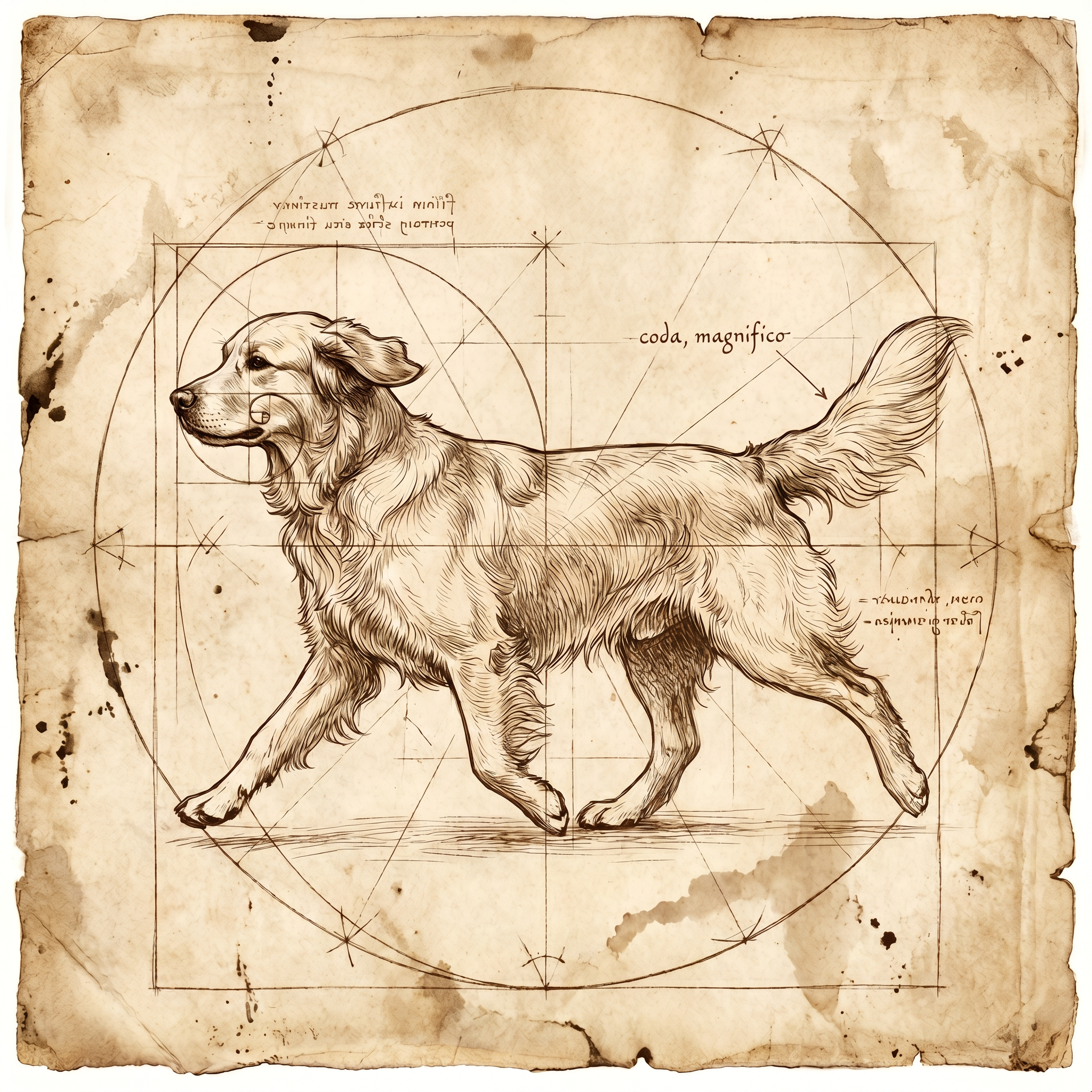
When you groom, you're working in response to that underlying architecture. The coat is the medium, but the structure beneath it is the brief. A good groom honours what's actually there: it finds the dog's best angles, softens what needs softening, emphasises what deserves emphasis. It makes the structure legible.
None of these elements exist in isolation. The length of neck in relation to the body. The depth of chest against the length of leg. The head in relation to everything beneath it. They're all in conversation with each other, and your eye is reading that conversation in real time, whether you know it or not.
What's remarkable is that the proportions that feel right tend to follow patterns that show up everywhere in nature and art. The golden ratio (roughly 1:1.618) is the most famous of these. It describes the relationship between a larger measure and a smaller one that the human eye consistently reads as balanced and beautiful. It appears in nautilus shells, in Renaissance painting, in architecture, in the spiral of a sunflower. It appears, too, in a well-structured dog when the groom has done its job.
Your eye already knows this ratio. You've been tracking it without knowing its name every time you've stepped back from a dog and felt something click into place, or felt something wasn't quite there yet.
Training the eye deliberately
Knowing that the eye is trainable changes how you approach your own development.
It means every dog you finish is an opportunity to look, not just to complete. It means studying photographs of great grooms with the same attention you'd give a painting in a gallery, asking not just "what did they do" but "why does this work." It means noticing the grooms that stop you and being curious about what, specifically, stopped you.
It means learning to sit with the feeling of wrongness without immediately reaching for the scissors. Sometimes the most useful thing you can do is name what's off before you fix it. That naming is what builds vocabulary, and visual vocabulary is what turns a feeling into a skill.
Watch educators who finish to a high standard and pay attention to where they pause. The pause before the final step back. The pause before they adjust something you hadn't noticed was wrong. That pause is the eye doing its work. It's not hesitation. It's looking.
The more you look, really look with attention rather than just checking, the faster the eye learns. It's building a reference library with every dog, every photograph, every competition finish you study. That library is what makes the knowing feel instantaneous later. It isn't instinct. It's ten thousand hours of looking, compressed.
This is what artists do
Painters study composition, sculptors study form, architects study proportion. They learn the principles not to apply them like rules, but to internalise them until the principles disappear and what's left is just an eye that knows.
That's the trajectory for every groomer who takes their work seriously. You study, you practice, you look, you adjust. And at some point the theory recedes and what's left is a body of work and an eye that sees clearly and a hand that follows.
That's art. Not craft with the ceiling raised. Art: the real thing, with all the subjectivity and rigour and deep satisfaction that comes with it.
The dog on your table is a canvas. The scissors and the comb and your trained eye are the tools. The finish is the thing you made.
Own it.
But first, a reality check
Here's the thing nobody’s putting on a grooming mood board.
For little Jerry: thirteen years old, arthritic, Maltese, done with everyone's nonsense. This is not an option. Jerry gets a kind hand, a gentle finish, and a liver biscuit on the way out. The art is getting him through it with his dignity intact and his heart rate relatively stable. Here, your heart leads. It tells the eye what to overlook and the hands how softly to move. Together they do the very best for this dog, and that is enough. That is everything.
For Daisy, the one-eyed cocker spaniel whose diabetes came courtesy of a daily Monte Carlo biscuit given with complete and total misguided love - this is not an option. But the art is still absolutely present. It's in making that little chonk look cute and feel comfortable. In finding her angles. In sending her back to Mary-Louise and Joe hovering outside the trailer looking like the best version of herself, high blood sugar and all. Heart first, always. The hands and the eye follow.
For the neighbourhood pets whose families are watching every dollar right now, this is not an option. They need a clean, comfortable, affordable groom from someone who cares. The heart knows when enough is enough, and it says so. That is also art, even if it never makes a mood board.
Most of the dogs on your table, on most days, are Jerries or Daisies, or the nervous nellies who just need a bath and a short back and sides to feel better and be allowed back on the couch. And you show up for them completely, because that's the job and you love the job.
But then →
Then the bookings turn over and there he is: a standard poodle, eight weeks of coat, brushed daily, practically vibrating with potential, already making eye contact like he knows what's about to happen. He is cooperative. He is magnificent. He is, frankly, showing off.
And you start to hear the beats in your chest. You look at him. He looks at you. Somewhere in the distance, Chariots of Fire begins to play. The artist in you leans forward and says: yes. Leonardo. You are mine today.
When these dogs show up, and they will, embrace them. Say yes to the finish that scares you a little. Take the extra ten minutes to step back and really look. Let the eye do the thing you've been training it to do.
How often these Leonardos walk through your door depends on your suburb, your clientele, and sometimes, who's running the country. But when they arrive, in whatever form they take, whatever breed, whatever clip, recognise the moments for what they are.
May you both exit through the gift shop together. ♥
With love,
igroomhub xx