
Asian Fusion is a set of proportions. Get those right and the style follows.
Flared legs, short body, poodle feet, teddy bear head. Bronson is a poodle mix who has been saving his coat for eleven weeks and he is an excellent model. Sue Wright works through his full Asian Fusion groom, and what becomes clear very quickly is that the style isn't really about the scissor skills - it's about the decisions that happen before them.
Every step Sue takes is a proportions decision. Where the blend line sits on the leg determines how long the leg looks. Where the muzzle width is set determines how the whole head reads. How high the top of the head goes determines whether the face looks balanced or top-heavy. The scissors and clippers are just how you execute decisions you've already made.
Why the pre-clip comes before the bath
Sue clips the pattern in before she puts Bronson in the bath - which is not how everyone approaches this style. Her reasoning is specific to this coat and this trim. Bronson has a lot of coat, and setting the pattern first means she's not bathing and drying hair she's about to remove. It also means the coat lies better after the bath, because the bulk has already been taken off and the remaining coat has somewhere to fall.
The pre-clip is rough - blocking in, not finishing. But getting those blend lines established early means the finishing clip after the bath is refinement rather than construction.
The blend line is everything on the legs
Asian Fusion flares are narrow at the top and wide at the bottom. The blend line - where the short body coat transitions into the longer leg coat - is what makes or breaks the illusion of length. Sue blends off two to three fingers above the elbow on the front legs, and from the top of the flank to the bend in the leg on the rear. Come down too far into the elbow dip and the leg looks short. Get the blend line right and the leg looks long.
“If we trim right down into here, you see, we’ve just got this section of leg. So we want to lengthen his legs. Blend higher up.”
She checks from above to confirm both sides match before moving on. It's a check she makes repeatedly throughout the groom - proportions only reveal themselves when you look at the whole dog, not just the section you're working on.
The muzzle is built in sections
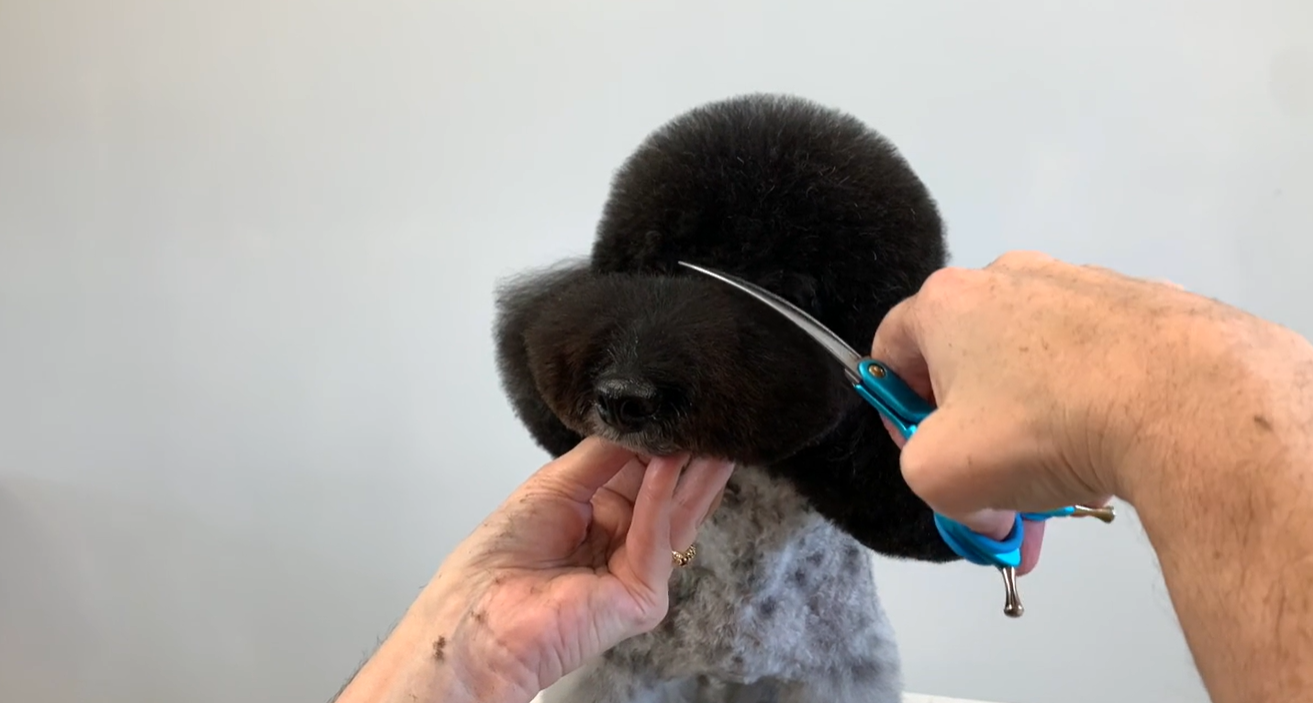
The Asian Fusion muzzle is the most complex part of this groom and the part that most groomers find hardest to get right. Sue's approach is to think of the muzzle in thirds - front, middle, back - and to work from the bottom up so that shorter hair at the base supports the longer hair above. Width is set early and protected throughout. The temptation to keep taking a little more off the sides is exactly what makes a muzzle end up looking narrow and pinched rather than round and full.
The visor is built in layers, combing a section forward and cutting from the centre of the nose to the outside corner of the eye, repeating three or four times. It's methodical rather than intuitive, and watching Sue do it makes the logic clear in a way that's very difficult to pick up from a description.
Balance is the finish line
Sue ends the groom by checking Bronson from every angle - front, side, above, behind. Not because she's uncertain, but because Asian Fusion is a style where small imbalances between one side and the other, or between the leg width and the head size, are immediately visible.
Sue's complete masterclass on Bronson is available to Members inside igroomhub, or available to rent at igroomschool.
Sue also teaches The Essential Guide to Asian Styling - her full course on igroomschool.