


ASIAN FUSION
Groodle
TAYLAN BRADLEY
BOBBY
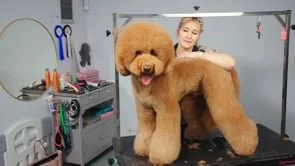
Big dog, big hair, big personality! Meet Bobby, the biggest Groodle on Tay's books and the proud owner of a rather spectacular hairdo. In this four-part tutorial, Tay demonstrates a salon-friendly Asian Fusion trim featuring a generous mushroom head, cute donut muzzle and fabulous flared legs.
Bobby's plush, curly coat carries a considerable amount of undercoat, making excellent preparation essential to achieving a soft, sculpted finish.
Throughout this tutorial, Tay shares some fantastic time-saving techniques, using her clippers to carve out shapes traditionally achieved with scissors. She also explains how to work towards a more exaggerated style over successive appointments, maintaining shape and coat condition while allowing length to develop in all the right places.
Part 1 | Body Styling & Clipper Carving
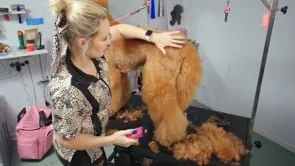
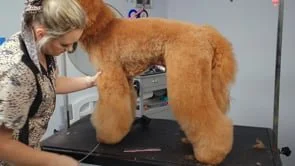
Tay establishes Bobby's silhouette using a 16mm attachment comb and a wide blade, creating a neat body that will accentuate his fuller legs and head. She works with Bobby's anatomy, introducing definition through the shoulders, tuck-up and hindquarters while retaining coat where needed for the overall style.
Switching to a one-inch attachment comb, Tay demonstrates her clipper carving technique, hovering over the coat to sculpt the legs without removing unnecessary length. It's an excellent technique for both salon and competition groomers looking to reduce scissoring time without compromising shape.
Part 2 | Flared Legs & Bevelled Feet
Working with an abundance of coat, Tay demonstrates her approach to establishing the foot perimeter before trimming underneath, helping to preserve the width and fullness required for a flared leg.
She works through the bevels, hocks and leg transitions, using curved and straight scissors to refine the shapes already established with her clippers. Tay explains how visualising the letter A helps create a flared silhouette rather than a traditional column leg, and how to maintain that shape while growing additional coat between appointments.
Part 3 | Sculpting the Mushroom Head
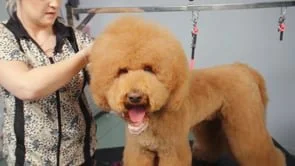
It's time for Bobby's signature feature! Tay works towards a large, rounded mushroom head with integrated, Bichon-inspired ears.
Beginning with the eyes, she creates shorter supporting layers to help prevent the weight of the longer coat from falling forward. She then works through the cheeks, ears and neck, explaining how to visualise and scissor a shape even when the coat required to complete it hasn't grown in yet.
Tay also discusses coat volume, product use, ear placement and why this particular head style may not be suitable for dogs prone to ear infections.
Part 4 | Donut Muzzle & Finishing Touches
Bobby is a dedicated drooler, so Tay takes this into consideration when sculpting his donut muzzle, working with the way his coat naturally sits rather than relying on a perfectly dry, fluffy finish.
She uses chunkers to remove bulk before refining the rounded muzzle with curved scissors. Moving to the back of the head, Tay demonstrates how to create a seamless transition from the shorter neck into the fuller dome, drawing on techniques similar to those used when shaping a Poodle crest.
A little final refinement brings Bobby's fabulous silhouette together.
KEY POINTS
Preparation is everything. Thorough removal of dead undercoat is essential for attachment combs to move freely through a dense, mixed coat and achieve an even finish.
Let your clippers do the heavy lifting. Use longer attachment combs and a hovering technique to carve out shapes, leaving your scissors for refinement.
Establish your markers. Creating the visible foot perimeter before trimming underneath helps prevent the removal of too much coat.
Think A, not I. Visualise the letter A when creating flared legs, retaining fullness towards the feet.
Work with the coat's natural fall. Comb, shake, allow the coat to settle and reassess before removing more length.
Make the eyes a feature. Shorter supporting layers above the eyes help keep longer head coat from falling forward without creating a surprised expression.
Scissor for the shape you're growing into. Visualise the finished silhouette and resist the temptation to remove coat from areas that are still developing.
Consider the individual dog. Adapt the style to suit coat texture, ear health, drooling and the dog's tolerance for grooming.
Connect your shapes. A gradual transition from the neck into the head creates a more cohesive silhouette.
Don't create work for yourself. Once the shape is established, refine what's there rather than repeatedly resculpting the entire area.