

Learning Dog Grooming: What Works, What Doesn’t, and Why

The question everyone keeps asking:“What’s the best way to learn dog grooming?”
It’s a question asked by people entering the industry, by groomers looking to improve, and by business owners trying to train staff. It’s also a question that rarely receives a clear answer. Advice usually sounds simple: get hands-on experience, do a course, or just keep grooming dogs. Each suggestion contains some truth, but none explains how learning actually unfolds in this industry, or why so many capable people still feel stuck or uncertain years into their careers.
This article looks at what we consistently see across the grooming industry, and what genuinely helps people build skill, confidence, and professional judgement over time.
What hands-on training does better than anything else
Dog grooming is a physical, sensory craft. There are aspects of learning that only hands-on experience can provide, and no amount of theory can replace them.
Hands-on training is where groomers develop body awareness, coordination, and safe working posture. It’s where tool handling becomes intuitive rather than conscious, and where timing, pressure, and flow are learned through repetition. These skills live in the body, not the head.
Practical work is also where groomers learn to read dogs in real time. Subtle shifts in weight, tension, breathing, and behaviour can only be recognised through direct interaction. Trust, restraint, and timing are felt before they are understood.
Just as importantly, hands-on experience teaches emotional regulation. Staying calm when a dog moves suddenly, when a groom doesn’t go to plan, or when time pressure builds is learned through exposure, not explanation. Real dogs are unpredictable, and practical training builds adaptability in a way no simulated learning can.
This is where confidence begins. Not from knowing what to do in theory, but from having done it, felt it, and navigated it safely.
Where hands-on learning struggles without structure
Hands-on learning becomes less effective when it exists without reflection or explanation. In busy environments, the focus is often on completion rather than understanding. Decisions are made quickly, adjustments happen on the fly, and there is little opportunity to slow down and unpack why something worked or didn’t.
Without structure, experience can become repetition rather than development. Groomers may repeat the same techniques without refining them, or absorb habits without understanding their impact. Learning becomes dependent on observation and trial and error, which can be slow and discouraging.
This is not a failure of practical training. It’s a limitation of unstructured learning environments. Experience alone does not guarantee growth.
What theory adds to hands-on learning
When theory is grounded in real grooming practice, it gives context to experience. It helps groomers understand what they are seeing, feeling, and doing, and why certain choices lead to better outcomes.
Good theory supports pattern recognition. It explains how coat types behave, how structure affects balance, why certain handling approaches reduce stress, and how preparation influences finish. It helps groomers make decisions instead of guessing, and adapt techniques rather than relying on habit.
Theory also shortens the learning curve. It reduces trial-and-error learning, which can be physically and emotionally exhausting. Instead of learning only through mistakes, groomers gain insight that supports safer, more confident practice.
Theory does not replace hands-on work. It sharpens it.
Time is rarely the real barrier. Structure is.
Many groomers say they don’t have time to learn. More often, learning feels overwhelming because it is fragmented or disconnected from daily work. Random tips, isolated videos, or occasional workshops rarely provide a sense of progression.
Learning works best when it is structured, revisit-able, and relevant to what someone is doing now. Small, focused learning done consistently supports far better outcomes than sporadic bursts of information.
Progress comes from rhythm, not pressure.
How grooming skill really develops
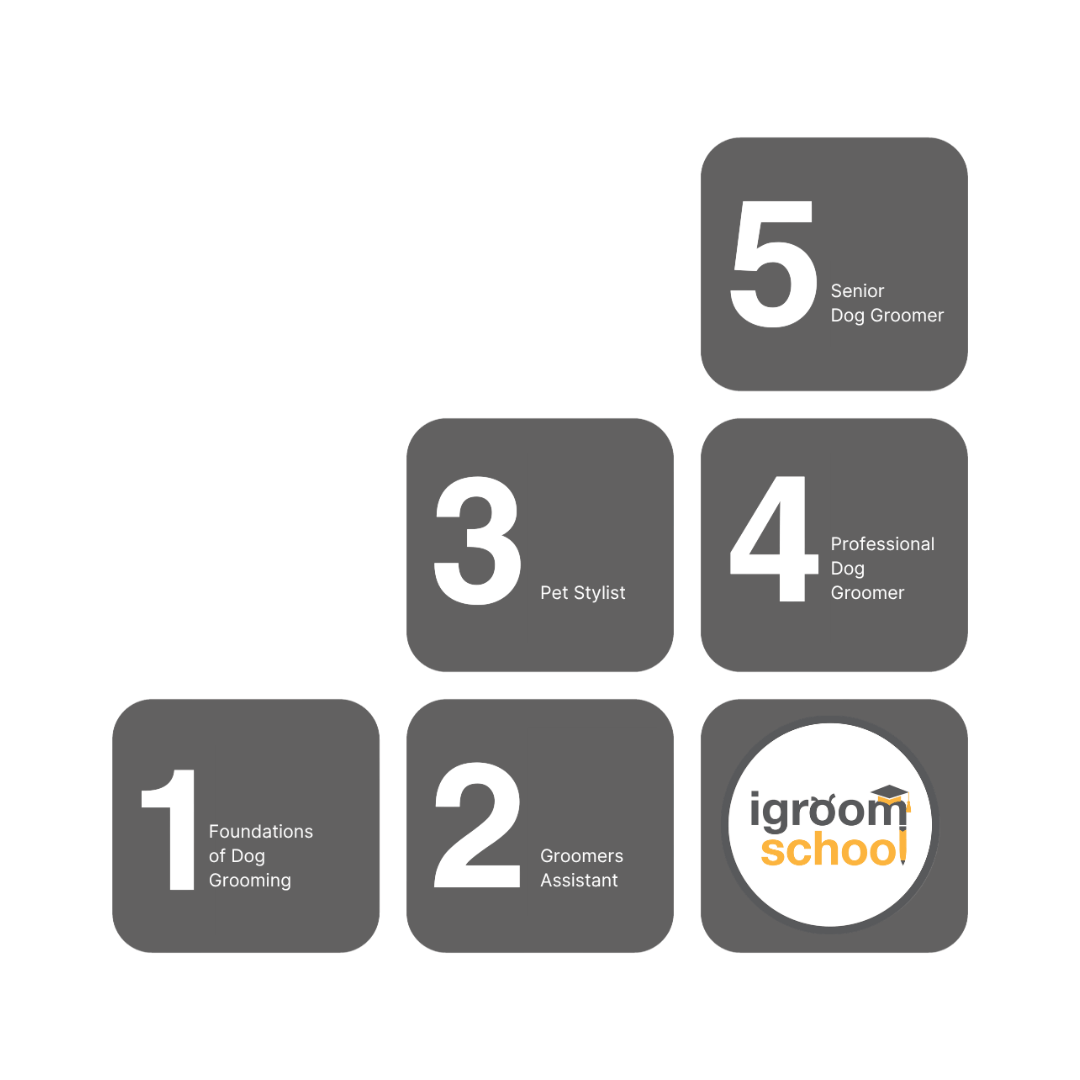
Skill in grooming develops in stages. First, tasks are learned individually. Then those tasks begin to connect. Over time, groomers learn to adapt under pressure, refine outcomes, and make independent professional judgements.
When these stages are rushed or skipped, gaps form. Those gaps often show up later as stress, inconsistency, injury, or lack of confidence. These outcomes are frequently mistaken for personal shortcomings, when they are more accurately signs of unsupported learning.
Strong learning systems respect progression. They recognise that finishing a course or mastering a basic routine is not the end of learning, but the foundation for deeper development.
So what truly works when learning dog grooming?
There is no single best path, but there are principles that consistently support strong learning outcomes.
Effective learning combines hands-on experience with structured theory. It allows skills to develop progressively rather than rushing competence. It includes feedback, reflection, and opportunities to revisit concepts as experience grows. It supports learning alongside real work, rather than treating education as something separate or finished.
Dog grooming is a skilled trade, with a strong craft element that develops over time through experience and ongoing learning.
The goal is not to finish learning. The goal is to become capable, confident, and thoughtful in how the work is done. That is what supports groomers, businesses, and the industry as a whole.



If your clients can't tell the difference between "we're closed" and "we're upset with you," that's not on them. That's a business with no system underneath the relationship.