The breed standard is the brief. The dog in front of you is the raw material. The groomer is the one who bridges the two.
One of the things we love about watching Alicia Fragiadakis work is how clearly you can follow her thinking. She's not just scissoring - she's narrating a decision-making process, and every decision traces back to the same question: what does this breed standard actually ask for, and how do I get this dog there?
Frank is a Kerry Blue Terrier, and Alicia is putting him through a show and high level grooming competition trim. Kerry Blues are, by Alicia's own description, one of the most complex and rewarding breeds to groom - a substantial, powerful terrier with a thick, wavy coat that requires real study before you attempt the trim. This is the kind of groom that takes years to understand and a lifetime to perfect, and watching Alicia work through it is a genuinely good way to start.
What the standard is asking for
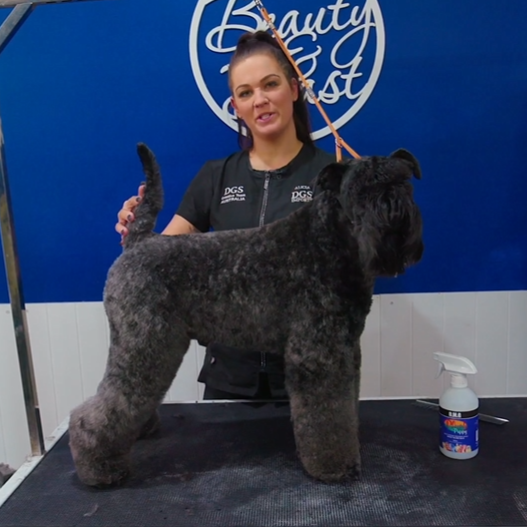
The Kerry Blue standard describes a compact, powerful terrier - upstanding, well knit, muscular and well developed. The body should be short coupled with good depth of brisket, well sprung ribs, a level topline and a deep chest. The neck is strong and reachy. The hindquarters large and well developed, stifle bent, hocks close to the ground. The coat soft, silky, plentiful and wavy.
That last point matters more than it might seem. A soft, wavy coat is not a stiff or inflated coat - which is why the only product Alicia puts near Frank is a spritz spray to aid scissoring and restore the wave afterwards. Volumising spray, hairspray, anything that changes the texture works against what the standard is specifically asking for. On a Kerry Blue, product choices are breed standard decisions.
Translating the standard into scissor decisions
The topline goes in first because once it's level and straight - as the standard requires - everything else can be worked off it. The neck transition is kept short and tight at the sides because too much volume there reads as wide rather than the strong, reachy neck the standard describes. The well sprung ribs are given shape with curves rather than straights, because rib cages are round and scissoring them flat produces exactly the slab-sided look the standard isn't asking for. The loin comes in fractionally shorter to make the spring of rib read as more defined.
The hindquarters are scissored to show the angulation the standard calls for - without going so far it looks artificial. The hocks sit close to the ground as required, and Alicia removes the hair above the hock point to make that read clearly. The front legs become cylinders: nothing sticking out from the elbows, flat shoulders as the standard specifies, the legs just clear of the chest rather than running straight off it.
And then there's Frank
Frank's facial furnishings were cut off a few months ago and are still growing back. His tuck up is light on coat. He is not the ideal specimen on the ideal day - and Alicia gets on with it anyway, shaping to the correct outline even without full length, scissoring the tuck up line to suggest the curve that should be there, working with what Frank can offer right now.
It's the part of this tutorial that sticks with you. The groom won't be perfect because the coat isn't there yet. But the structure is correct, the balance is right, and Alicia knows that when the coat grows in it will sit exactly where it needs to. That patience - the willingness to do the right thing for the dog even when the result won't be complete today - is what show and competition grooming demands. And honestly, it's a good way to think about every groom.
Alicia's complete masterclass on Frank is available to Members inside igroomhub, or you can rent it for six weeks on igroomschool.