Hand stripping an Irish Terrier: when the dog is still learning
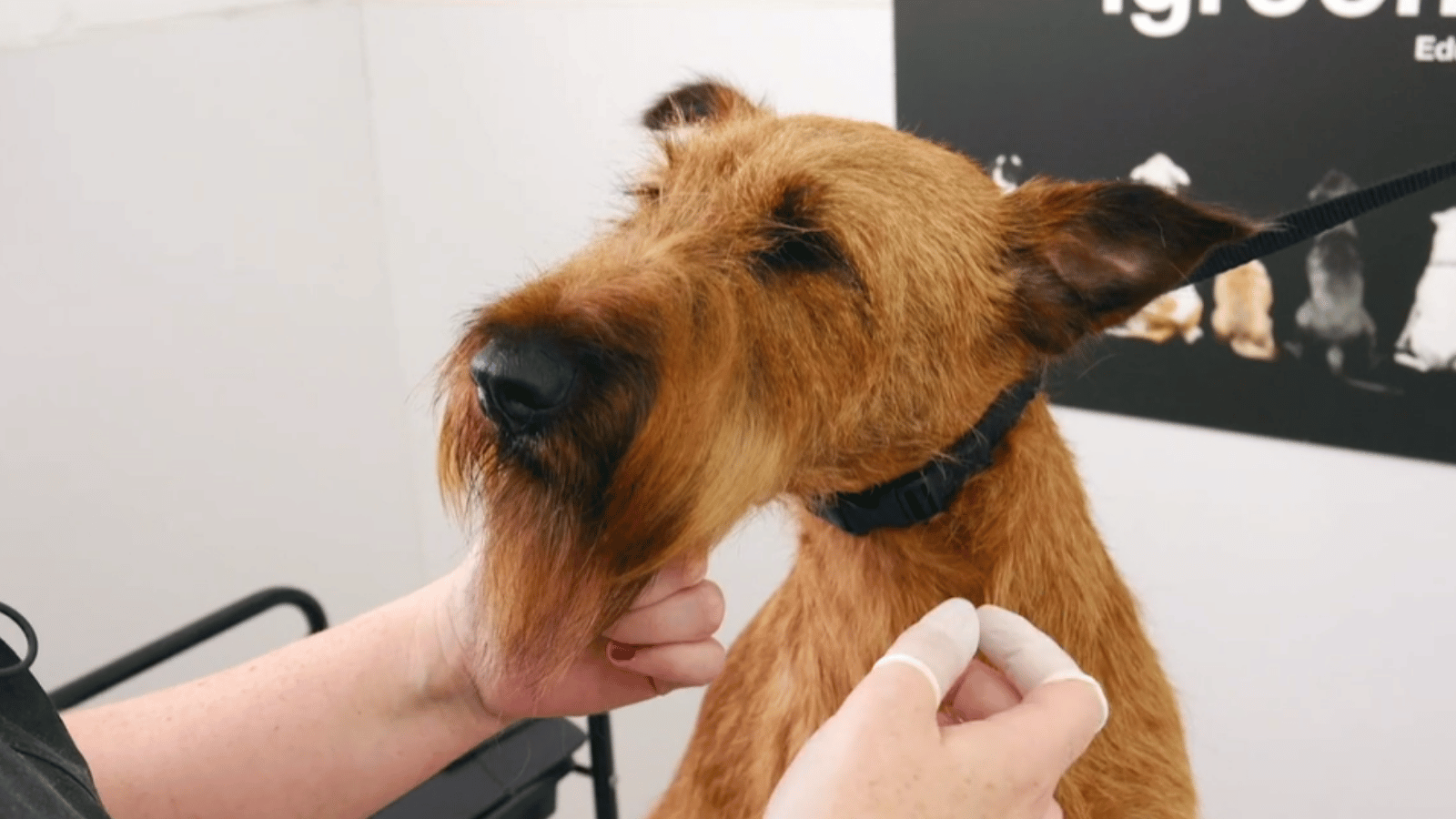
Murphy is an Irish Terrier, nine months old, and this is only his second hand stripping session. He's been in once before, about eight weeks ago. Michelle Weber knows going in that this isn't going to be a straightforward top-to-tail groom. Murphy is a puppy, he's a terrier, and he has opinions.
What makes this tutorial interesting isn't just the Irish Terrier technique - it's watching how Michelle reads the dog throughout and adjusts her plan accordingly. She ends up doing his back jacket, neck, head and ears rather than the full groom, because that's what Murphy can handle in one session. How you build a dog that will tolerate hand stripping for the rest of its life.
The neck takes longer than you think
Michelle flags early that the neck is one of the most time-consuming parts of an Irish Terrier groom, and the cowlicks are the reason. The coat doesn't grow in one direction through the neck - it changes grain - so you have to strip in two different directions to get it lying flat. Going against the grain doesn't just look wrong, it's uncomfortable for the dog and harder on the coat.
On a dog like Murphy who is still building his tolerance, the neck is also where you need to read him carefully. If he's had enough, pushing through on a sensitive area like this is going to make the next visit harder, not easier.
What Irish Terriers need
Irish Terriers are a tight, muscular breed - not heavily furnished, not a lot of undercoat. The goal is a short, flat jacket that shows the dog's muscle and lets that characteristic deep red colour come through. Because the coat is predominantly guard coat with very little undercoat underneath, Michelle doesn't reach for carding knives at all during this groom. There's simply nothing to card.
The pumicestone does most of the work on the jacket - it removes bulk coat efficiently without the risk of grabbing too deep. For more delicate areas - the neck, the head, around the ears - she switches to thumb and finger with finger cones, partly for control and partly because Murphy is still working out how much of this he's willing to put up with.
“Ideally I want this nice and tight to show off his muscles and get that beautiful colour coming through.”
Working the head on a young dog
The Irish Terrier head is flat - minimal stop, flat skull, cheeks that are present but not bulging. No hair past the corner of the eye toward the mouth. A small beard. Ears tight and clean, stripped rather than clipped if you want to preserve the colour and texture underneath.
On Murphy, the head work is incremental. Michelle strips a section, praises him, moves to another part of the dog when he's had enough, then comes back. The ears in particular - she gets further than she expects because she gives him a break first and returns when he's settled. It's not a linear process. It's negotiation.
“You can clip ears if you need to, but it will damage the coat, so you won’t have this beautiful colour that I’m finding underneath.”
Training tolerance is part of the groom
The thing that runs through this entire session is the idea that what you're doing with a young dog isn't just grooming - it's building a working relationship. Every time Murphy gets through a section he finds difficult, that's a deposit in the bank for next time. Every time Michelle reads that he's done and moves on rather than pushing through, she's protecting that relationship.
It means this visit doesn't produce a finished dog. It produces a dog that will come back in eight weeks slightly more willing than he was today. Which, for a breed that needs to be hand stripped regularly for its entire life, is the only result that actually matters.
Michelle's full session with Murphy is inside igroomhub - covering jacket technique, neck and head work, ear stripping, and how to manage a young dog that's still learning to tolerate the process. Watch the Irish Terrier masterclass with Michelle Weber.